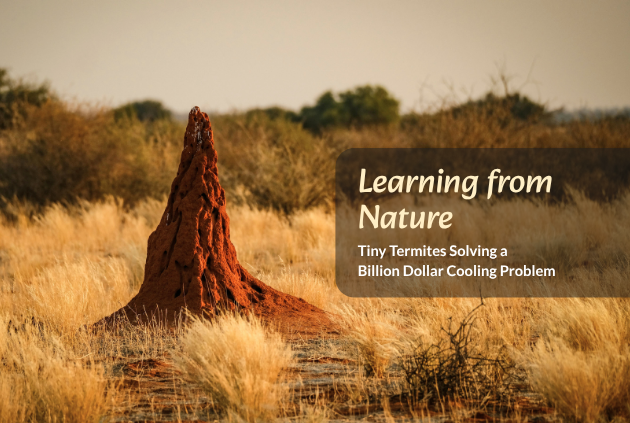
Despite being blind, termites build towering mounds that are several metres high and can last up to a 100 years. These strong and resilient mounds have a natural air conditioning system that funnels hot air out of a ‘chimney’ at the top, consequently drawing in cooler air from ‘vents’ in the bottom to replace it.
This continuous circulation of air creates a self-regulating system that helps maintain and regulate temperature inside the mound despite skyrocketing temperatures outside.
Architect Mick Pearce drew inspiration from this system while designing The EastGate Center in Zimbabwe. The building allows natural ventilation to replace energy – consuming technologies by creating the same chimneys, vents, channels and air chambers at strategic points in the center. Despite having no conventional air-conditioning or heating, the building stays regulated year round and uses 90% less energy than a conventional building its size!
The Billion Dollar Cooling Problem
The world’s buildings are facing a critical cooling problem and the cost of not addressing it, is in the billions. In India, the urban heat island effect has blanketed metropolitans and Bengaluru’s weather is no longer as pleasant as it was when it boasted the title, ‘The Garden City’. As the temperature rises and ravages the city, we must look to non-traditional, cost effective measures to cool our buildings.
By emulating the interconnected and complex design found in termite mounds, we can design buildings that efficiently distribute airflow throughout the structure and reduce both costs and dependence on traditional air conditioning, heating and ventilation technologies.
Biomimicry at Ekya Vana
At Ekya Vana, stories like this help students see nature as a guide for innovation. Understanding the habits of termites can help students eventually explore how to:
- Design self-regulating buildings
- Create more resilient building materials
- Build sustainable and long-lasting structures
- Utilise decentralised systems to create complex infrastructure.
Through biomimicry, students learn to observe patterns, structures, and systems in the natural world. They become curious, creative and responsible stewards of the planet. They start to recognise that the natural world is not separate from innovation, it is one of its greatest sources.
It seems fitting then, when the CEO of the Biomimicry Institute, says our design challenge is to “realign ourselves with life’s genius”. At Ekya Vana, our students observe and learn from nature, approaching problem solving in a unique, innovative and transformative way. They develop the mindset of systems thinkers who understand and act on the fact that the natural world is full of intelligent solutions.
Because yes, a termites home can teach us a thing or two about how to cool our own.