Can you imagine robots using nature’s design?
It may sound surprising, but some of the most advanced robotic arms are actually inspired by an elephant’s trunk.
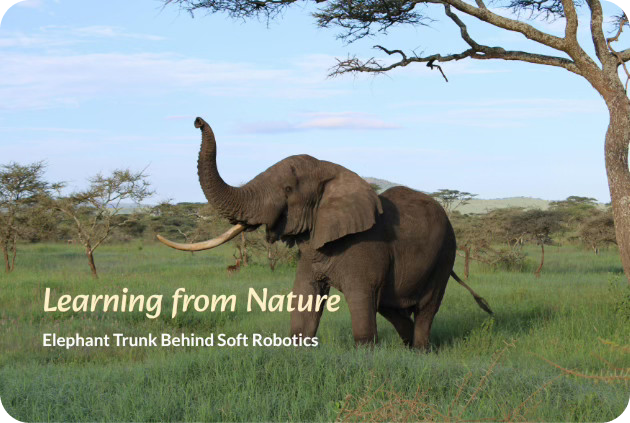
An elephant can move its trunk effortlessly in almost any direction. It can hold up to around 10 litres of water, curl it above its head to splash, pick up something as small as a peanut, or lift heavy objects—all thanks to its complex muscle structure that allows incredible flexibility and control.
This remarkable natural design has inspired one of the most sophisticated systems created by humans. Engineers use the elephant trunk as a blueprint for developing flexible robotic arms that combine strength, precision, and adaptability.
This is the idea behind biomimicry learning from nature’s time-tested designs to solve human challenges. At Ekya Vana, we believe nature is not only something to protect, but also something to learn from. When students observe the natural world closely, they begin to discover that many of the solutions to modern problems already exist around us.
The Strategy: Muscular Hydrostats structure
Elephants use their trunks to drink water, spray it over themselves, and pick up objects of all sizes. To perform such varied tasks, the trunk must bend and move freely in almost any direction, something that wouldn’t be possible if it were supported by bones.
Instead, the trunk is a muscular hydrostat-a structure made entirely of muscles with no bones or joints. Similar systems are found in a snake’s tongue and an octopus’s arm. These organs rely on a complex arrangement of muscle fibers to support themselves and create movement.
The key principle behind a muscular hydrostat is constant volume. Since muscles are largely made of water and are nearly incompressible, the overall volume of the trunk remains constant as it moves. This means that when one part of the trunk contracts in a particular direction, another part must expand or adjust to compensate.
This unique mechanism allows the elephant’s trunk to achieve remarkable flexibility, precision, and strength, all without the need for rigid support.
Engineers have turned to the elephant’s trunk as a model for designing a new generation of robotic arms—often called soft or continuum robots. Unlike traditional robots with rigid joints and fixed movements, these bio-inspired systems are built to be flexible, adaptable, and precise.
From trunk to tech: When elephant designs were used in Robotics
The elephant trunk’s muscular hydrostats structure with no bones and the ability to bend in any direction has inspired robotic arms that use flexible materials, cables, and air pressure systems to create smooth, continuous motion. This allows robots to move more like living organisms rather than machines with limited angles of rotation.
One of the biggest advantages of this design is the ability to combine strength with delicacy. Just like an elephant can lift heavy logs or pick up a tiny peanut, these robotic arms can handle fragile items like fruits or medical tools, while also performing tasks that require power. This makes them especially useful in fields like healthcare, rescue missions, manufacturing, and agriculture.
Learning By Nature at Ekya Vana
At Ekya Vana, stories like this help students see nature in a new way—not just as something to admire, but as a guide for innovation.
Through biomimicry, students learn to observe patterns, structures, and systems in the natural world. They begin asking questions like:
-
Why do certain shapes reduce resistance?
-
How do natural designs move efficiently through air, water, or soil?
-
What can we learn from nature when designing new products or systems?
These questions help students develop the mindset of systems thinkers – people who understand that the natural world is interconnected and full of intelligent solutions.
Learning through the ‘nature’s way of solving’
Biomimicry helps children see nature as a teacher, not just something to observe. By exploring how an elephant’s trunk works, flexible, strong, and precise without any bones, kids can begin to think like young innovators. They can experiment with simple materials like cloth, sponges, straws, or tubes to create their own “flexible tools” that bend, grip, or lift objects. This hands-on learning builds curiosity, problem-solving, and creativity, encouraging them to ask, “How would nature solve this?”
Over time, such thinking can inspire them to design useful solutions like
-
Gentle grabbers
-
Flexible water sprayers
-
Assistive tools
Showing them that innovation doesn’t always start in a lab, but often in the natural world around them.