What If the Fastest Technologies Were Inspired by Birds?
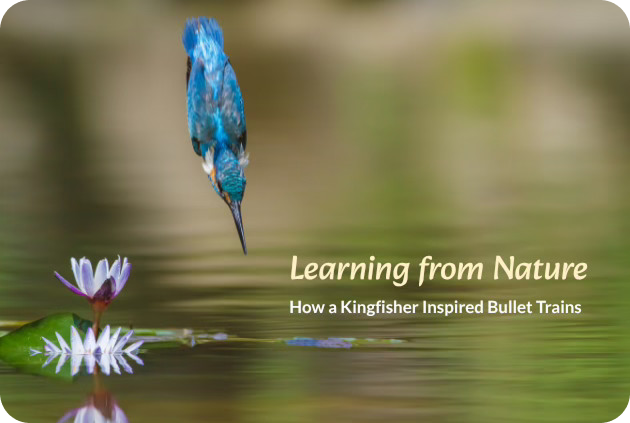
Imagine watching a bird dive into water so smoothly that it barely creates a splash.
No loud disturbance.
No dramatic ripple.
Just a precise, effortless entry into the water.
Now imagine if that same natural design could help improve one of the fastest trains in the world.
This is the idea behind biomimicry learning from nature’s time-tested designs to solve human challenges. At Ekya Vana, we believe nature is not only something to protect, but also something to learn from. When students observe the natural world closely, they begin to discover that many of the solutions to modern problems already exist around us.
One small bird—the kingfisher—offers a powerful example of this.
The Strategy: A Beak Designed for Streamlining
Kingfishers are expert hunters. From above the water, they spot fish below the surface and dive rapidly to catch them.
But fish are extremely sensitive to disturbances in water. Even a small splash can alert them and send them swimming away.
So how does the kingfisher dive so effectively?
The answer lies in the shape of its beak.
The kingfisher’s beak is long, narrow, and gradually widening. This smooth, tapered shape allows it to move from air into water with very little resistance or splash. Instead of pushing water aside abruptly, the beak allows water to flow smoothly around it.
In design terms, this shape is called streamlined. It reduces drag and pressure, allowing movement to happen efficiently and quietly.
Nature has solved a complex physics challenge through form and function.
When Engineers Looked to Nature
This natural strategy did not go unnoticed.
In Japan, high-speed bullet trains once faced a problem when exiting tunnels. As the trains moved at very high speeds, air pressure built up in front of them inside tunnels. When the train emerged, that pressure released suddenly, creating a loud “tunnel boom”.
Engineers needed a way to reduce the noise while keeping the trains fast and efficient.
One engineer, who happened to be a birdwatcher, noticed how a kingfisher dives into water without creating a splash. Inspired by this, engineers redesigned the nose of the bullet train to mimic the shape of the kingfisher’s beak.
The result was remarkable.
The train became quieter, faster, and more energy efficient.
A bird’s beak helped improve one of the most advanced transportation systems in the world.
Learning By Nature at Ekya Vana
At Ekya Vana, stories like this help students see nature in a new way—not just as something to admire, but as a guide for innovation.
Through biomimicry, students learn to observe patterns, structures, and systems in the natural world. They begin asking questions like:
-
Why do certain shapes reduce resistance?
-
How do natural designs move efficiently through air, water, or soil?
-
What can we learn from nature when designing new products or systems?
These questions help students develop the mindset of systems thinkers people who understand that the natural world is interconnected and full of intelligent solutions.
From Observation to Innovation
The kingfisher’s beak teaches an important design principle: gradual transitions reduce resistance and disruption.
Once students understand this concept, they can begin applying it in many ways.
For example, they might explore how streamlined shapes could help:
-
design quieter vehicles
-
improve water flow in irrigation systems
-
create more efficient transport systems
-
develop products that move smoothly through air or water
Through this process, students learn that innovation does not always begin with new technology—it often begins with careful observation of nature.
Why This Matters for the Future
Nature has spent millions of years refining designs that are efficient, balanced, and sustainable.
When students learn to observe and learn from these systems, they begin to think differently about design and problem solving. They start to recognise that the natural world is not separate from innovation, it is one of its greatest sources.
At Ekya Vana, biomimicry helps students develop curiosity, creativity and responsibility towards the planet.
Because sometimes, the solution to a complex human problem might already exist in the quiet dive of a bird.