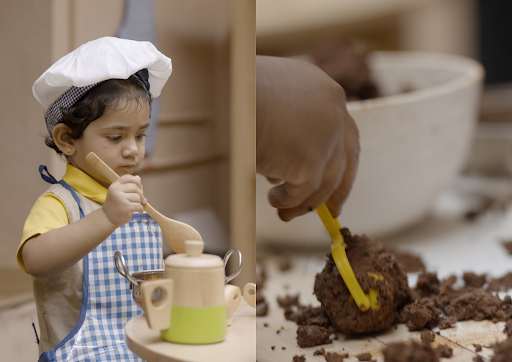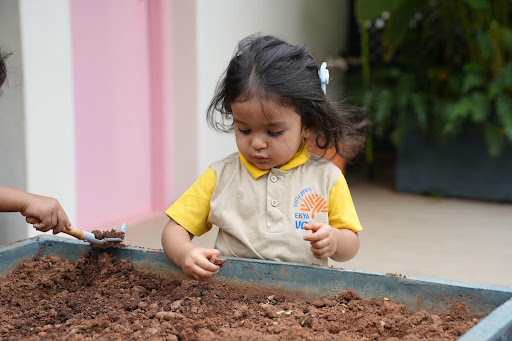
What if some of the most important lessons your child learns begin with a tiny ant, a fallen leaf, or a puddle after the rain?
Imagine a child sitting in a garden, watching a line of ants carry tiny pieces of food. They notice how the ants move together, navigate obstacles, and disappear into the soil.
Soon, the questions begin.
Where are they going? Why are they walking in a line? Where do they live?
What began as a simple moment of curiosity becomes an opportunity to explore science, observation, problem-solving, and the connections between living things.
No worksheet. No predetermined answers. Just a child discovering the world through experience.
This is where nature-based learning begins.
At Ekya Vana Early Years, a nature-based preschool in Bangalore, we believe that nature is more than a place for children to play. It is a living learning environment that encourages children to explore, question, discover, and grow.
What Is Nature-Based Learning?
When we think about learning in nature, we often picture children going on nature walks, collecting leaves, or creating artwork using flowers.
While these experiences are valuable, nature-based learning goes much further.
It is an educational approach where the natural world becomes an integral part of how children learn and understand their surroundings.
Instead of simply teaching children about plants, we encourage them to observe how a seed grows.
Instead of explaining the water cycle only through pictures, we invite them to notice puddles disappearing after the rain.
Instead of introducing insects through flashcards, we create opportunities for children to observe them in their natural habitats.
The difference is simple: children are not just learning about nature. They are learning through nature.
This approach encourages children to develop curiosity, confidence, independence, and a deeper understanding of the world around them.
When Curiosity Becomes the Starting Point for Learning
Young children are naturally curious.
They want to know why leaves fall, where butterflies go, why soil feels different after rain, and how tiny seeds become tall plants.
Nature offers endless opportunities to explore these questions.
Consider a child planting a seed.
They begin by touching the soil, noticing its texture, and carefully placing the seed into the ground. Over the following days, they water it, observe changes, and wait for the first signs of growth.
Through this one experience, they begin to explore:
- Science: Understanding what plants need to grow and how living things change.
- Mathematics: Counting leaves, comparing heights, and recognising patterns.
- Language: Describing observations, asking questions, and sharing discoveries.
- Responsibility: Learning to care for something that depends on them.
- Patience: Discovering that growth takes time.
This is the beauty of experiential learning. A single experience can open the door to multiple areas of development.
Children are not simply receiving information. They are actively building their understanding of the world.
Why First-Hand Experiences Matter in Early Childhood
Think about the difference between showing a child a picture of a butterfly and allowing them to watch one settle on a flower.
In the picture, they see its colours and wings.
In the garden, they notice how it moves, where it lands, and what happens when they approach it.
The experience encourages questions that a picture alone might never inspire.
Young children learn through their senses. They explore the world by touching, observing, listening, moving, and experimenting.
The texture of soil, the sound of falling rain, the smell of leaves, and the movement of insects all provide meaningful opportunities for discovery.
In a city like Bangalore, where urban living and screen time can limit children’s everyday experiences with the natural world, these opportunities become especially important.
A nature-based preschool in Bangalore can help create space for children to build a relationship with nature through regular, meaningful experiences.
Technology can introduce children to new ideas, but direct interaction helps them connect those ideas to the world around them.
How Nature-Based Learning Supports the Whole Child
The benefits of nature-based learning extend beyond academic understanding.
Outdoor environments offer children space to move, explore, experiment, and develop confidence in their abilities.
When children balance on a log, walk across uneven ground, or build using natural materials, they develop coordination, balance, and problem-solving skills.
When they collaborate to build a structure using fallen branches or create patterns with stones, they learn to communicate, share ideas, and work together.
Nature also offers opportunities for emotional well-being.
Research suggests that experiences in natural environments can support children’s attention, physical activity, stress regulation, and overall well-being.
A quiet moment watching clouds, listening to birds, or observing a plant allows children to slow down and become more aware of their surroundings.
These experiences support holistic early childhood development, nurturing children intellectually, physically, socially, and emotionally.
Before Children Can Protect Nature, They Must Know It
We often speak about raising environmentally responsible children.
We want them to conserve water, care for plants, reduce waste, and understand the importance of protecting the planet.
But where does this sense of responsibility begin?
For a young child, sustainability is not something learned only through definitions or instructions.
It begins with everyday experiences.
A child who cares for a plant begins to understand that living things need attention.
A child who watches birds building a nest begins to recognise how animals depend on their surroundings.
A child who notices dry soil starts to understand why water matters.
These small moments gradually help children recognise the relationships between living things and their environment.
More importantly, they encourage children to develop a personal connection with nature.
Before children learn why they should protect the Earth, they need opportunities to experience what makes it worth caring for.
Environmental awareness becomes more meaningful when it grows from connection rather than instruction alone.
Why Nature-Based Education Should Begin in the Early Years
Early childhood is a period of extraordinary growth.
It is when children begin forming habits, attitudes, relationships, and ways of understanding the world.
They are learning to ask questions, make choices, express emotions, solve problems, and build connections with people and places.
Nature provides a rich environment for all these experiences.
Unlike activities where every step and outcome is predetermined, the natural world invites exploration.
A fallen leaf might become the beginning of a story.
A puddle might inspire an experiment.
A stone might become part of a mathematical pattern.
A garden might lead to a conversation about caring for living things.
Each experience creates new possibilities for learning, shaped by children’s observations, questions, and interests.
At Ekya Vana Early Years, we believe that these experiences help nurture curious, thoughtful, and independent learners.
Nature is not simply a break from learning. It is part of the learning itself.
A Different Way to Experience Preschool in Bangalore
For parents exploring preschool education in Bangalore, the learning environment is an important consideration.
Beyond classrooms, activities, and academic readiness, there is a deeper question worth asking:
What kind of relationship do we want our children to build with the world around them?
Nature-based education offers a thoughtful perspective.
It encourages children to engage with real experiences, learn through exploration, and develop an understanding of the natural world.
At Ekya Vana Early Years, our philosophy places curiosity, meaningful experiences, and connection with nature at the heart of early childhood learning.
The intention is not simply to help children understand the world as it is today, but to nurture the confidence, empathy, and adaptability they will need as they grow.
Where Learning Takes Root
At its heart, nature-based learning is about giving childhood the space it deserves.
Space to wonder.
Space to explore.
Space to make discoveries that cannot always be planned in advance.
It reminds us that education is not only about what children know, but also about how they come to understand the world and their place within it.
At Ekya Vana Early Years, we envision a childhood where natural curiosity meets the richness of the world around us, nurturing a lifelong love for learning and discovery.
Because the most meaningful lessons do not always begin with a question from a teacher.
Sometimes, they begin with a child looking closely at a tiny ant and asking,
“I wonder where it’s going?”
And that simple question can be the beginning of something extraordinary.
For parents searching for the best preschool Bangalore has to offer, perhaps the most important question is whether the environment gives children the freedom to explore, discover, and grow with curiosity.
Discover a different approach to early childhood education at Ekya Vana Early Years, where learning grows naturally.