What if the muddy shoes we worry about are actually signs of a childhood well spent?
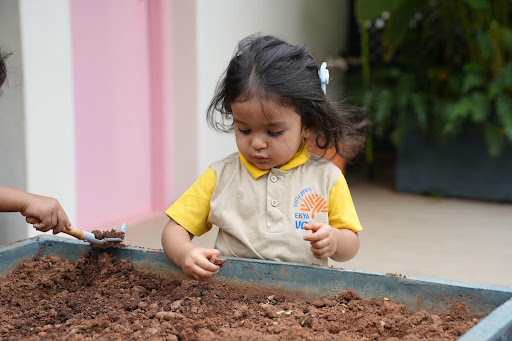
A child returns home with mud on their shoes, a leaf tucked into their pocket, and a hundred stories to tell. Perhaps they discovered an earthworm after the rain, watched ants carry food, or spent the afternoon figuring out why some leaves float while others sink.
To an adult, it might look like messy play. To a child, it is a world of discovery.
Somewhere along the way, we began associating clean uniforms, spotless shoes, and tidy surroundings with good learning. But childhood was never meant to be entirely neat.
At Ekya Vana Early Years, we believe some of the most meaningful learning experiences begin when children have the freedom to explore, ask questions, and connect with the natural world around them. For parents searching for the best preschool Bangalore has to offer, these opportunities for meaningful exploration are an important part of early childhood education.
Before Classrooms Had Walls, Nature Was a Teacher
Long before modern classrooms, learning in India often took place in close connection with nature.
The ancient Gurukul tradition offers one example of education that extended beyond textbooks. Learning could involve observing one’s surroundings, participating in daily responsibilities, and understanding the relationship between people and the environment.
While education has evolved considerably since then, one idea remains relevant: children learn about the world by experiencing it.
A tree can become a lesson in growth. A puddle can spark questions about water. A garden can introduce children to patience, responsibility, and the interconnectedness of living things.
Nature does not always provide ready-made answers. Instead, it invites children to observe, wonder, experiment, and discover.
And isn’t that what meaningful learning should encourage?
When Did We Become Afraid of Muddy Shoes?
As parents, we naturally want our children to be safe, healthy, and comfortable.
We remind them not to step into puddles, climb onto muddy surfaces, or get their clothes dirty. These reminders often come from a place of care.
But sometimes, in our efforts to protect children from discomfort, we unintentionally limit opportunities for exploration.
A puddle becomes something to avoid rather than investigate. A patch of soil becomes dirt rather than a miniature ecosystem. A fallen branch becomes a mess rather than the beginning of an imaginative adventure.
Young children are naturally curious. They want to touch, collect, build, observe, and experiment.
When we allow children to explore safely, we give their curiosity room to grow.
A muddy shoe can be cleaned. A missed opportunity for discovery is harder to recreate.
What Nature Teaches That Textbooks Cannot
Imagine a child kneeling beside a small plant, carefully examining its leaves.
They notice that the soil feels damp. They wonder why one leaf is yellow while another is green. They discover a tiny insect hiding underneath.
In those few moments, several kinds of learning are happening.
Science begins with observation. Children notice patterns, ask questions, and begin making connections between living things and their surroundings.
Problem-solving grows through experimentation. Whether they are building a small channel for water or finding a way to balance stones, children test ideas, make mistakes, and try again.
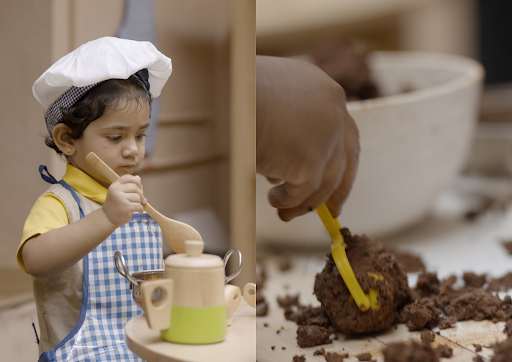
Creativity emerges naturally. A stick becomes a bridge. A collection of leaves becomes artwork. A patch of earth becomes an imaginary world.
Emotional well-being finds space to flourish. Outdoor experiences offer opportunities for movement, sensory exploration, and a change of pace. Research also suggests that time in natural environments can support children’s well-being, attention, and emotional health.
Empathy develops through connection. When children observe a butterfly, care for a plant, or watch an earthworm move through the soil, they begin to recognise that the world is shared with other living beings.
These experiences may appear simple, but they create the foundations for deeper understanding.
Sustainability Begins With a Sense of Wonder
We often think of sustainability as something children must learn when they are older.
We introduce concepts such as conservation, climate change, recycling, and protecting the environment.
But before children can understand why the Earth needs protecting, they need opportunities to experience what makes it worth caring for.
A child who has watched a seed sprout understands that plants need care.
A child who has observed birds building a nest begins to notice how animals depend on their surroundings.
A child who has spent time exploring soil, water, and trees begins to recognise that nature is not something separate from everyday life.
This connection is where environmental responsibility can begin.
At Ekya Vana Early Years, the philosophy of nature-connected learning encourages children to see the environment not simply as a topic of study, but as a living world to observe, appreciate, and care for. As a preschool in Bangalore, Ekya Vana brings this philosophy into its approach to early childhood learning.
Before children learn to protect nature, they must first have the opportunity to fall in love with it.
Let Them Get Messy. Let Them Figure It Out
Consider a child trying to build a bridge using stones and sticks.
The first attempt collapses.
They move a stone, add another stick, and try again.
Perhaps the bridge falls a second time. Perhaps a friend joins in with a new idea.
What looks like ordinary outdoor play is also an opportunity to practise persistence, collaboration, creativity, and flexible thinking.
Children do not always need adults to provide immediate solutions.
Sometimes, they need time.
Time to investigate.
Time to make mistakes.
Time to wonder what might happen next.
When we allow exploration to unfold with thoughtful guidance and appropriate safety, we help children build confidence in their own ability to learn.
From Muddy Shoes to Mindful Learners
The early years are a time when children begin developing their relationship with the world.
Every sensory experience, every question, and every small discovery can contribute to how they understand their surroundings.
Nature offers a rich environment for this learning.
It encourages children to slow down and notice. To listen to the sounds around them. To feel different textures. To recognise changes in seasons, weather, and living things.
These experiences nurture more than knowledge.
They can help children develop curiosity, independence, empathy, and a sense of belonging to something larger than themselves.
At Ekya Vana Early Years, this is the spirit we hope to nurture: children who are free to wonder, confident enough to explore, and thoughtful about the world they share.
For families choosing a preschool in Bangalore, nurturing these qualities during the early years can be just as meaningful as preparing children for the next stage of their education.
A Little More Mud, A Little Less Worry
The next time your child comes home with muddy shoes, perhaps ask a different question.
Instead of, “How did you get so dirty?”
Try, “What did you discover today?”
You might hear about a worm hiding beneath a stone, a puddle that became an ocean, or a leaf unlike any they had seen before.
You might discover that an ordinary afternoon was filled with extraordinary learning.
Because childhood is not measured by how clean children stay.
It is shaped by the questions they ask, the experiences they gather, and the wonder they carry with them.
So let there be muddy shoes, curious hands, and endless questions.
After all, some of the most beautiful lessons in life begin with a little dirt.
Ekya Vana Early Years | Where curiosity takes root and learning grows naturally.